|
|
Acquisition |
Processing |
Comments |
| Date: 08/01/2010 |
DeepSkyStacker |
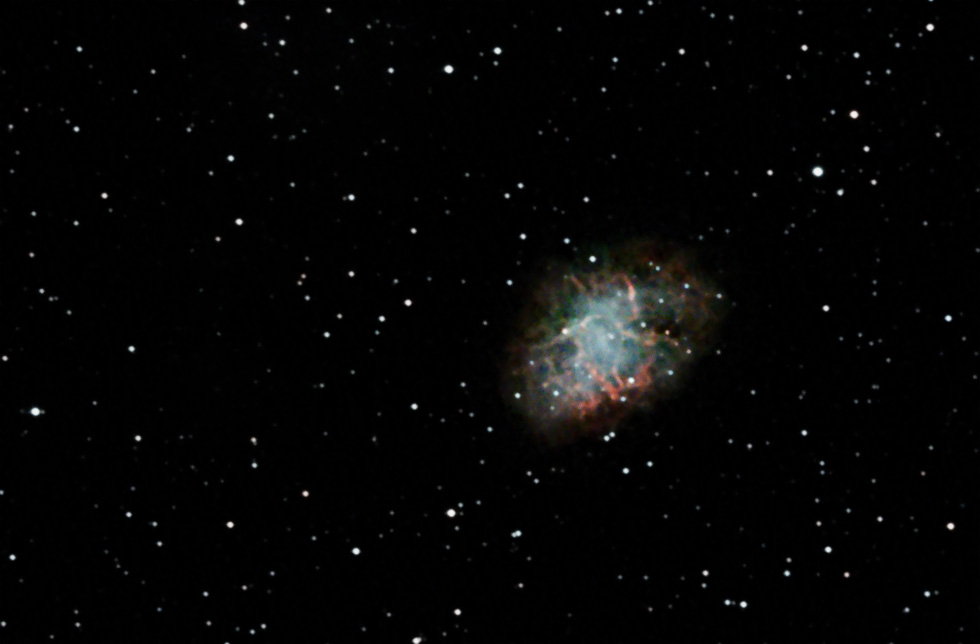
Name: The Crab Nebula - M1 - Mag 8.4 On the 4th July 1054 or earlier, in April or May of that year, a new bright star was observed in Taurus. The star was so bright it could be seem with the naked eye even in the daylight. The star was a supernova and the nebula we see today represents the outer layer of the exploding supernova. The remaining star in the centre is a pulsar which measures only 10km in diameter and a cubic centimetre of its matter would weigh a thousand million tons, so much has it been compressed in the gravitational collapse of the supernova ! The nebula itself is an astonishing 10 light years in diameter. To put that into perspective, if the Sun were the size of a basketball, the Crab Nebula would be the size of planet Earth. Keep in mind it's expanded to this size in only 950 years ! The link between the Chinese astronomers observations in 1054 to what we now know as the Crab Nebula was only made by astronomers during WWII.
|
| Location: Greenwood WA - Backyard | Stacking Mode: Mosaic | |
| Camera: Canon 20D - LP Filter Removed | Alignment Method: Automatic | |
| Optics: Mead LX200R | Stacking Mode: Mosaic | |
| Exposure: 800ASA - 13 x 420 Seconds | RGB BKG Cal: Yes | |
| Total Exposure: 1 Hour 31 Minutes. | Per Channel Cal: Yes | |
| Guiding: DSI on Skywatcher ED80. | Method: Median Kappa-Sigma K=2/I=5 | |
| Filter: Astronomik CLS-CCD | Darks: Yes | |
| Focus: Bahtinov Mask | Flat: No | |
| Full Details | ||
|
Position in Sky |
PhotoShop CS4 |
|
| RA (J2000): 05 h 34.5 Min | Levels, Colour Balance, Curves, Saturation Scaling, jpeg Conversion. | |
| DEC (J2000): +22 Deg 1 Min | ||
| Constellation: Taurus | ||
| Distance: 6,500 Light Years |